
How Do Symptom Navigators Affect Patient Actions?
Or, what did Ada Health report about using Ada Health?
There’s quite a bit of interesting in using digital symptom triage these days. Patients are using them, after all – so why not health systems?
This report illustrates the findings of a convenience sample of patients using an Ada Health product as a navigator for care by one of Ada Health’s clients, written up by – you guessed it – Ada Health. You can imagine these data have all the resilient integrity of a sandcastle.
But, here’s what they’re selling:
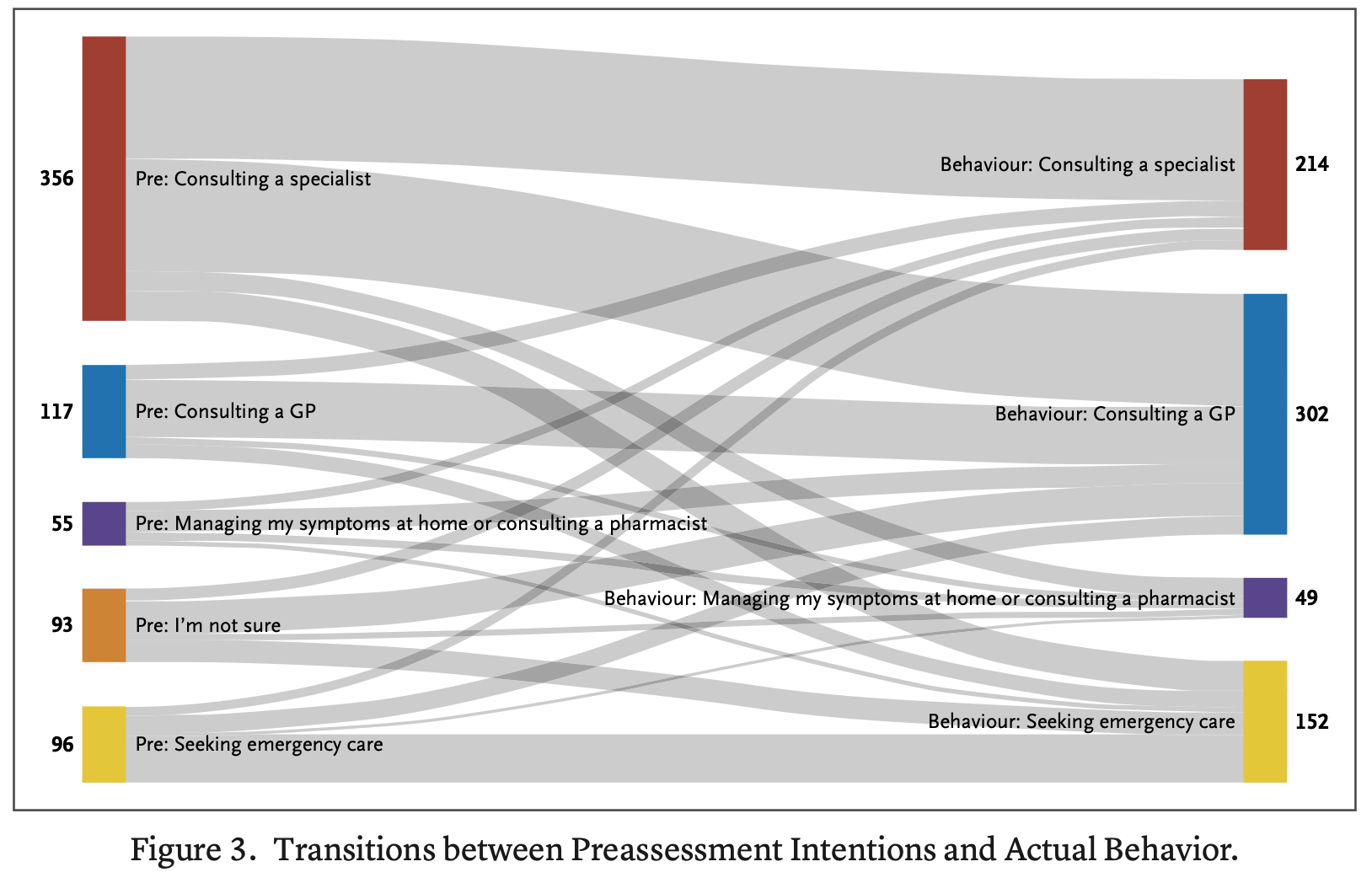
Patients came to the Ada Health platform, implemented for a private healthcare provider in Portugal, considering specialty care and were re-triaged to GPs. The prevailing narrative across the study is that their platform safely redirects patients to a “more appropriate” care setting. Bravo.
Whether these have either internal or external validity is highly suspect. The authors prompted 33,000 to take part in these surveys of pre-Ada Health intention and captured a mere self-selected 1,400 – half of which they lost to follow-up, leaving the 700-odd shown in the Sankey diagram above. Then, much depends on the healthcare environment wrapping around the entrants into a platform such as this – meaning the generalizability will be limited by the resemblance of your patient population to those belonging to this private healthcare organization, and the resources the organization has to offer. Finally, it’s Ada Health reporting on Ada Health, which always raises questions regarding things Left Unsaid (née Unreported).
Regrettably, this is likely just another piece of mostly unhelpful fluff. There are some funny bits – patients probably didn’t actually do what they said they would do when they had a post-encounter survey! – but the vast majority of this is fairly unrevealing.